Dallas receives an average of 39 inches of rain per year — but it's distributed so unevenly that drought stress is a constant reality for landscape plants. Summer months from June through August can go weeks without meaningful rainfall while temperatures push past 100°F. The result? Water bills that spike, lawns that brown, and ornamental plants that need daily irrigation just to survive.
The good news: you don't have to choose between a beautiful landscape and a reasonable water bill. Drought-tolerant landscaping (often called xeriscaping, though that term has some baggage) is about working with the climate instead of fighting it. Here's how to build a Dallas landscape that looks stunning while using 50% less water than a traditional design.
What Drought-Tolerant Landscaping Actually Means
First, let's clear up a misconception: drought-tolerant landscaping doesn't mean "no water" or "just rocks and gravel." It means selecting plants and designing systems that are adapted to the local climate and require minimal supplemental irrigation once established.
In practice, a well-designed drought-tolerant Dallas landscape includes:
- Native and adapted plants that evolved to thrive in North Texas conditions
- Strategic grouping by water needs (hydrozoning) so you're not watering cacti next to hydrangeas
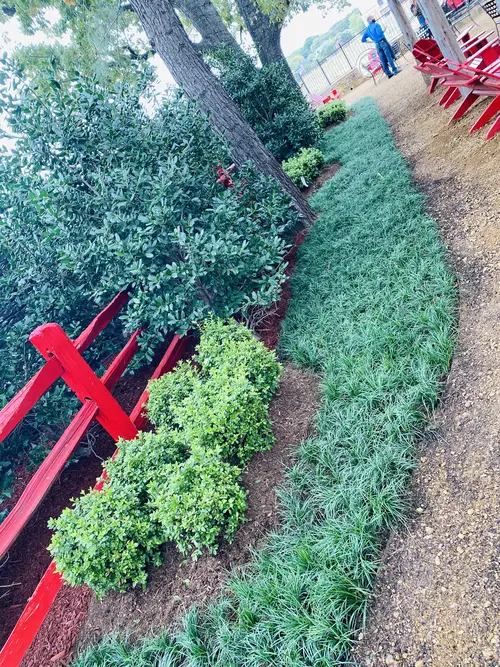
- Generous mulching to reduce evaporation and moderate soil temperature
- Efficient irrigation (drip lines for beds, smart controllers for turf)
- Reduced turf area — grass is the thirstiest component of any landscape
Top Drought-Tolerant Plants for Dallas
These plants are proven performers in North Texas Zone 8a. They look their best with minimal water once established (typically after the first growing season).
Shrubs & Hedges
- Agarita (Mahonia trifoliolata): Native Texas shrub with blue berries, yellow spring flowers, and excellent fall color. Handles full sun to partial shade. Zero supplemental water needed after year one.
- Yucca (various species): Architectural, low-maintenance, and virtually indestructible in Texas heat. Softleaf yucca and Spanish bay yucca are top performers.
- Desert Willow (Chilopsis linearis): A small tree that produces stunning purple-pink flowers from May through October. Thrives in full sun with minimal water.
- Leatherflower (Cephalanthus occidentalis): Native shrub/small tree with fragrant white flower balls. Tolerates both drought and occasional wet feet — incredibly versatile.
- Blanket Flower (Gaillardia pulchella): Native wildflower that blooms continuously from spring to frost. Handles full sun and poor soil.
Ground Covers & Perennials
- Blackfoot Daisy (Melampodium leucanthum): Native ground cover with continuous yellow daisy-like blooms. Spreads easily and handles foot traffic.
- Tickseed (Coreopsis): Multiple native species available. Blooms from spring through fall, handles drought beautifully once established.
- Lantana: Not native but extremely well-adapted to Texas heat. Continuous color from spring to frost, attracts butterflies, and shrugs off drought.
- Sedum (Stonecrop): Succulent ground cover that forms a dense mat. Perfect for slopes, rock gardens, and areas where mowing is difficult.
- Creeping Phlox: Spring bloomer that forms a carpet of color. Once established, needs very little water.
Trees
- Redbud (Cercis canadensis): Native Texas tree with spectacular pink/purple spring blooms. Moderate water needs, handles clay soil well.
- Live Oak (Quercus virginiana): The iconic Texas tree. Deep root system means minimal supplemental water needs after establishment. Provides massive shade value.
- Palmetto (Sabal palmetto): Native palm that handles heat, wind, and drought. Low maintenance and adds tropical character.
- Chinese Fringe Tree (Chionanthus retusus): Small shade tree with white summer blooms. Handles urban conditions and moderate drought well.
Hydrozoning: The Key Design Principle
The single most impactful change you can make to reduce water use is to group plants by water requirement. This is called hydrozoning, and it's the foundation of efficient landscape design.
Zone 1: High Water (Turf & New Plantings)
Your lawn and any newly planted trees/shrubs in their first year go here. This zone gets the most irrigation — typically 1 inch per week during peak season. Minimize this zone's area to reduce overall water use.
Zone 2: Moderate Water (Established Ornamentals)
Most traditional ornamental shrubs, perennials, and small trees fall here. They need supplemental water during extended dry spells but can handle 1–2 weeks without irrigation once established.
Zone 3: Low Water (Drought-Tolerant & Native Plants)
Natives, succulents, cacti, and other xeric plants. These need minimal to no supplemental water after the first year. A good rain event is often all they need.
By separating these zones, you avoid the wasteful practice of watering your agave as much as your hydrangeas. Each zone gets exactly what it needs — no more, no less.
Reducing Turf Area: The Biggest Water Savings
Here's an uncomfortable truth: your lawn is responsible for 50–70% of your landscape's water use. If you want to dramatically cut your water bill, reducing turf area is the single most effective strategy.
You don't have to eliminate grass entirely. Consider:
- Replacing rear yard turf with native ground covers and wildflowers
- Converting high-maintenance front yard areas to mulched beds with drought-tolerant plantings
- Adding a native meadow in the back yard — it looks natural, attracts pollinators, and needs mowing only 2–3 times per year
- Expanding hardscape areas (patios, walkways) to reduce the total planted area
A typical Dallas home with 5,000 sq ft of turf uses approximately 45,000–60,000 gallons of supplemental water per year. Replacing half that turf with drought-tolerant plantings saves 20,000–30,000 gallons annually — enough to fill an Olympic swimming pool.
Irrigation Efficiency Upgrades
If you're keeping some turf, make sure your irrigation system is as efficient as possible:
Switch to Drip Irrigation for Beds
Sprinklers waste 30–50% of their water to evaporation and wind drift. Drip lines deliver water directly to the root zone with minimal loss. For established beds, converting from sprinkler heads to drip emitters can cut bed irrigation water use by half.
Install a Smart Controller
Weather-based irrigation controllers adjust watering schedules automatically based on local evapotranspiration data. They prevent overwatering after rain events and increase watering during heat waves. Most pay for themselves in water savings within 2–3 years.
Add Soil Moisture Sensors
These sensors measure actual soil moisture at the root depth and only trigger irrigation when the soil is genuinely dry. They eliminate the "just in case" watering that wastes thousands of gallons per year.
Fix Leaks & Misaligned Heads
A single leaking sprinkler head can waste 500+ gallons per day. A misaligned rotor spraying pavement wastes water continuously. A professional irrigation audit can identify and fix these issues in one visit.
Mulching: Your Best Friend
A 3-inch layer of organic mulch around plants reduces evaporation by up to 70%, moderates soil temperature, suppresses weeds, and gradually improves soil structure as it decomposes.
Best mulch options for Dallas:
- Hardwood bark mulch: Classic look, breaks down over 2–3 years, good for most ornamental beds
- Cedar mulch: Longer-lasting (4–5 years), aromatic, slightly more expensive
- Gravel or decomposed granite: Zero maintenance, never needs replacement, ideal for xeric/drought-tolerant zones
- Wood chips (free from tree services): Functional and free, though less aesthetically refined than processed mulch
Want a Water-Wise Landscape Design?
We design and install drought-tolerant landscapes that reduce water use by 50%+ while looking better than traditional designs. Free consultation for Dallas-area properties.
Get a Free EstimateGetting Started: A Practical Plan
You don't need to tear out your entire landscape overnight. Here's a phased approach that delivers results over 2–3 years:
Phase 1 (This Season): Quick Wins
- Audit your irrigation system and fix any leaks or misaligned heads
- Install a smart controller if you don't have one
- Add 3 inches of mulch to all beds
- Identify the 1–2 areas where turf could be replaced with ground cover
Phase 2 (Next Spring): Planting Changes
- Replace one section of turf (500–1,000 sq ft) with native ground covers and drought-tolerant perennials
- Convert sprinkler heads in that zone to drip irrigation
- Add 2–3 specimen drought-tolerant trees or shrubs for structure
Phase 3 (Year 2): Expansion
- Expand the drought-tolerant area based on what's working
- Convert remaining high-water beds to hydrozone 3
- Consider a native meadow area in the back yard
- Evaluate overall water use and adjust irrigation schedules
The Bottom Line
Drought-tolerant landscaping in Dallas isn't about sacrificing beauty — it's about choosing plants and systems that are actually suited to the climate you live in. The result is a landscape that looks better with less work, costs less to maintain, uses less water, and supports local ecology.
Every gallon you save is money in your pocket and water in the Trinity River basin. Every native plant you add is habitat for pollinators and birds that are disappearing from urban Texas. It's landscaping that makes sense ecologically, economically, and aesthetically.