
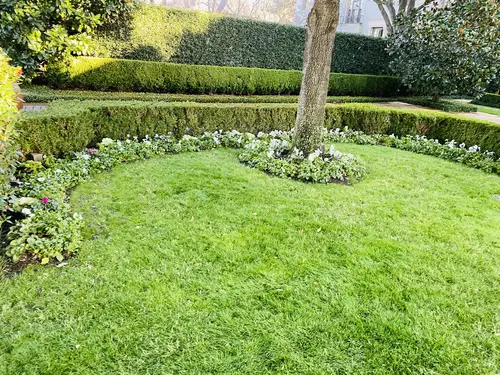
Here's a truth that surprises most Dallas homeowners: the health of your lawn next spring is determined by what you do this fall. While the summer months get all the attention, September through October is when warm-season grasses perform their most critical biological functions — storing energy, strengthening roots, and preparing for dormancy.
Skip these fall tasks and you'll wake up in March to a thin, weak lawn that takes weeks to green up and struggles throughout the season. Do them right, and your grass will emerge from winter dormancy dense, dark green, and ready to dominate. Here's exactly what needs to happen and why.
Why Fall Matters More Than Summer
During the summer, your warm-season grass is in full production mode — putting energy into above-ground growth (blades and stems). It's working hard to survive 100°F heat and competing with weeds for resources.
In fall, the equation flips. As days shorten and nighttime temperatures drop below 70°F, the plant shifts its energy allocation from top growth to root development and carbohydrate storage. This is the window where you can influence how much energy gets stored and how strong the root system becomes going into winter.
Think of it like this: summer is the marathon, and fall is where your lawn packs its survival kit for the winter hibernation. What goes into that kit determines how well it performs when it wakes up in spring.
The Three Pillars of Fall Lawn Care
1. Fall Fertilization (The Most Important Application of the Year)
Your fall fertilizer application should be different from your summer applications. The goal isn't to promote lush top growth — it's to strengthen the plant internally.
What to look for:
- Higher potassium (K): Potassium strengthens cell walls, improves drought tolerance, and enhances cold hardiness. Look for fertilizers with a K value of 15–20 or higher.
- Moderate nitrogen (N): You still need some nitrogen to support root growth, but less than summer rates. Aim for 1–1.5 lbs of N per 1,000 sq ft.
- Slow-release formulation: A controlled-release nitrogen source feeds the roots steadily over 6–8 weeks rather than giving a quick flush that promotes top growth you don't want.
Timing: Apply between mid-September and mid-October in Dallas. The ideal trigger is when nighttime temperatures consistently drop below 75°F. Too early and you're still in summer mode; too late and the grass won't have time to use the nutrients before dormancy sets in.
Common mistake: Using the same high-nitrogen summer fertilizer in fall. This promotes tender top growth that gets killed by the first hard freeze, leaving the plant with depleted reserves.
2. Fall Aeration
If you only aerate once a year, make it in the fall. Here's why:
- Root zone access: As the grass shifts energy to roots, those roots need oxygen and space to expand. Compacted Dallas clay soil restricts this expansion dramatically.
- Fertilizer absorption: Aeration holes created in September allow your fall fertilizer to penetrate directly to the root zone rather than sitting on the surface where it evaporates or washes away.
- Overseeding success: If you're overseeding thin areas, the aeration holes provide perfect seed-to-soil contact for germination.
- Thatch management: Core aeration pulls up plugs of thatch, breaking down the layer between living grass and soil.
How deep: For most Dallas residential lawns, 3–4 inches of core depth is sufficient. Heavily compacted areas or high-traffic zones may benefit from 5-inch cores.
Frequency: Once per year minimum for clay soils. If your lawn has significant compaction (water pools on the surface after rain), consider aerating twice — once in spring and once in fall.
3. Overseeding & Repair
Fall is the best time to address thin or bare areas in your lawn. The cooler temperatures, adequate moisture, and reduced weed competition create ideal germination conditions.
Option A: Overseed with warm-season grass
- Best for small bare patches (less than 10 sq ft)
- Use the same variety as your existing lawn
- Seed rate: follow package instructions (typically 1–2 lbs per 1,000 sq ft for spot seeding)
- Keep moist daily until established (2–3 weeks)
Option B: Temporary cool-season cover crop
- Best for larger thin areas where you want winter color
- Perennial ryegrass or annual rye are common choices
- Provides green color from October through March
- Dies naturally in April as warm-season grass takes over
- Requires more frequent mowing during winter (every 7–10 days)
Option C: Sod replacement
- Best for large dead areas (more than 25% of lawn)
- Fall installation gives new sod 4–6 weeks to establish before dormancy
- More expensive upfront but provides instant results
- Critical to water heavily the first 2 weeks post-installation
Additional Fall Tasks
Weed Management
Some weeds that were suppressed by summer heat become aggressive in fall. Crabgrass starts to die back, but winter annuals like henbit and chickweed begin germinating.
- Pre-emergent for winter weeds: Apply in October to prevent henbit, chickweed, and other cool-season weeds from establishing.
- Post-emergent for existing weeds: Fall is actually an excellent time for herbicide application because many weeds are actively growing (unlike dormant summer conditions).
- Hand-pull in beds: Clear out any volunteer plants or weeds that colonized your landscape beds during the summer.
Mowing Adjustments
- Gradually lower mowing height: Start at 3.5 inches in September and work down to 2.5–3 inches by November. This reduces the surface area exposed to winter winds and frost.
- Reduce frequency: As growth slows, you can stretch from weekly to every 10–14 days.
- Last mow before dormancy: Make your final cut at 2.5–3 inches, about 2 weeks before the first expected hard freeze. This "winterization cut" protects the crown.
Leaf Management
Dallas live oaks drop leaves throughout fall. While a thin layer of leaves is actually beneficial (they decompose into organic matter), a thick layer will smother grass.
- Mow over light leaf cover: If leaves are less than ½ inch deep, mow them into the lawn. They'll decompose quickly and add nutrients.
- Rake or blow heavy accumulations: Once leaves exceed 1 inch or start to mat together, remove them. A thick leaf layer blocks light and air, killing the grass underneath.
- Don't wait until December: Remove leaves in stages throughout October and November rather than one massive cleanup after the ground freezes.
Irrigation Transition
- Reduce watering frequency: As temperatures cool, your lawn's water needs drop significantly. Cut back from summer schedules by 25–50%.
- Shift to deeper, less frequent watering: This encourages roots to grow deeper in search of moisture, strengthening the plant for winter.
- Last irrigation before dormancy: Give the lawn a final deep watering about 1 week before the first hard freeze. This helps the soil retain moisture through winter and prevents desiccation from cold winds.
Let Us Handle Your Fall Lawn Care
Our seasonal programs include fall fertilization, aeration, and overseeding — all scheduled at the optimal time for your property. One call covers the entire critical window.
Get a Free EstimateFall Lawn Care Timeline for Dallas
| When | Action |
|---|---|
| Mid-September | Core aeration, begin overseeding thin areas |
| Late September | Apply fall fertilizer (high potassium) |
| October | Pre-emergent for winter weeds, reduce mowing height gradually |
| November | Final mow at 2.5–3", remove heavy leaf cover, last deep watering |
| December | Dormancy begins. Minimal maintenance. Plan spring projects. |
The Bottom Line
You can't change the summer heat or the winter cold. But you absolutely can control how well your lawn prepares for both. The fall window is your opportunity to invest in root strength, energy storage, and density that will pay dividends all next year.
If you do only three things this fall, make them these:
- Aerate — give those roots room to grow
- Fertilize with potassium — build cold tolerance from the inside out
- Repair thin areas — fill gaps now while conditions favor germination
Do those three things right, and your lawn will thank you every single day next growing season.