
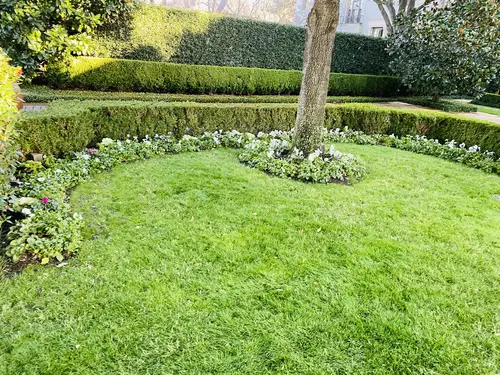
Fertilizer is the most misunderstood aspect of lawn care in Dallas. Homeowners either over-apply it (burning their grass and polluting waterways) or under-apply it (wondering why their lawn looks thin and yellow despite "fertilizing regularly"). The truth is somewhere in between, and getting it right requires understanding three things: what your grass actually needs, when it needs it, and how much is too much.
This guide breaks down fertilization for warm-season grasses in North Texas — the science, the timing, the products, and the mistakes to avoid.
Understanding N-P-K: What's on the Bag
Every fertilizer label shows three numbers, like 16-4-8 or 15-0-15. These represent the percentage by weight of three primary nutrients:
Nitrogen (N) — The Growth Driver
Nitrogen is the most important nutrient for turfgrass. It drives above-ground growth — greener color, faster blade production, and denser coverage. It's also the most mobile nutrient, meaning it leaches easily with rain and irrigation. This is why nitrogen applications need to be timed with active growth periods.
For Dallas lawns: You'll apply nitrogen 3–4 times per year during the growing season. Total annual nitrogen should not exceed 4–5 lbs per 1,000 sq ft for most warm-season grasses.
Phosphorus (P) — The Root Builder
Phosphorus supports root development, energy transfer, and overall plant vigor. Most established Dallas lawns don't need supplemental phosphorus unless a soil test indicates a deficiency. In fact, excess phosphorus runoff is a major contributor to waterway algae blooms, and many municipalities now restrict phosphorus in lawn fertilizers.
For Dallas lawns: Check your soil test. If phosphorus levels are adequate (most urban soils are), use a fertilizer with 0 or low P. New sod or seed installations benefit from a starter fertilizer with higher P.
Potassium (K) — The Stress Fighter
Potassium doesn't drive visible growth like nitrogen does. Instead, it strengthens cell walls, improves drought tolerance, enhances disease resistance, and helps the plant handle temperature extremes. Think of it as the "insurance policy" nutrient.
For Dallas lawns: Potassium becomes especially important in fall (for winter hardiness) and during summer heat stress. A higher-K fertilizer in September/October is one of the most impactful applications of the year.
The Dallas Fertilization Schedule
Here's the application schedule we follow for warm-season grasses in North Texas. Adjust timing by 1–2 weeks based on actual weather conditions each year.
| Application | Timing | N-P-K Focus | Purpose |
|---|---|---|---|
| Spring Kick-Start | Mid-March | High N (15-0-15) | Wake up dormant grass, drive initial growth |
| Early Summer | Late April | Balanced (16-4-8) | Support peak growth period |
| Mid Summer | Late June | Moderate N (12-0-12) | Maintain density through heat stress |
| Fall (Critical) | Mid-September | High K (10-0-20) | Strengthen roots, build cold tolerance |
The fall application is the most important one of the year. It's when your grass is shifting energy from top growth to root storage. A high-potassium fertilizer at this time directly translates to a stronger, denser lawn next spring.
How Much Fertilizer Do You Actually Need?
This is where most homeowners go wrong. They see "apply 1 lb per 1,000 sq ft" on the bag and assume that's the amount of nitrogen. It's not — it's the amount of fertilizer product, which contains only a percentage of actual nitrogen.
Here's how to calculate:
- Determine your lawn area: Measure length × width for rectangular areas. For irregular shapes, divide into rectangles or use a GPS app.
- Read the N-P-K on the bag: The first number is the percentage of nitrogen. A 16-4-8 bag is 16% nitrogen by weight.
- Calculate nitrogen needed: For a 5,000 sq ft lawn needing 1 lb of N per 1,000 sq ft, you need 5 lbs of actual nitrogen.
- Calculate product needed: 5 lbs ÷ 0.16 (16%) = 31.25 lbs of fertilizer product.
Annual nitrogen budget for Dallas warm-season grasses:
- Bermuda: 4–5 lbs N per 1,000 sq ft per year (highest feeder)
- St. Augustine: 4–5 lbs N per 1,000 sq ft per year
- Zoysia: 3–4 lbs N per 1,000 sq ft per year
- Buffalo: 2–3 lbs N per 1,000 sq ft per year (lightest feeder)
Types of Fertilizer: What to Buy
Quick-Release vs. Slow-Release Nitrogen
- Quick-release (urea, ammonium sulfate): Available to the plant within 24–48 hours. Good for a fast color response but requires more frequent applications and leaches easily with rain.
- Slow-release (polymer-coated, urea-formaldehyde): Releases nitrogen over 6–12 weeks. Fewer applications needed, less leaching risk, more consistent feeding. Slightly more expensive per bag but often better value over the season.
- Our recommendation for Dallas: Use slow-release for spring and summer applications (fewer visits, less waste). Quick-release is fine for the fall application when you want a steady feed over the 6–8 week dormancy transition.
Granular vs. Liquid
- Granular: Applied with a spreader, lasts longer between applications, easier to store. Best for most residential lawns.
- Liquid: Applied with a hose-end sprayer or backpack sprayer, faster absorption, good for spot treatment. Best for small areas or when you need a quick response.
Organic vs. Synthetic
- Organic (blood meal, fish emulsion, compost): Feeds soil biology first, which then makes nutrients available to the plant. Slower response (2–4 weeks) but builds long-term soil health. Lower nitrogen concentration means you need to apply more product.
- Synthetic: Directly available to the plant within days. Faster results, more precise dosing. Doesn't build soil organic matter over time.
- Practical approach: Use synthetic for the 3–4 scheduled applications and supplement with organic matter (compost top-dressing, mulch) annually. This gives you fast results plus long-term soil improvement.
Common Fertilization Mistakes in Dallas
Mistake #1: Fertilizing Dormant Grass
Applying nitrogen to dormant (brown) warm-season grass in winter is wasted money. The grass can't uptake the nutrients, so they leach into groundwater or run off into storm drains. Wait until you see active green growth before applying.
Mistake #2: Fertilizing in Extreme Heat
When temperatures are consistently above 95°F, grass goes into heat stress and reduces its nutrient uptake. Fertilizer applied during a heat wave sits on the surface, burns the thatch layer, and provides little benefit. Wait for a break in the heat or hold until September.
Mistake #3: Too Much Nitrogen
More is not better. Excess nitrogen causes lush, tender top growth that's more susceptible to disease, pests, and heat stress. It also promotes thatch buildup and increases water needs. Stick to the annual budget — 4–5 lbs N per 1,000 sq ft is the ceiling for most Dallas lawns.
Mistake #4: Not Watering In
Granular fertilizer doesn't work until it dissolves and reaches the root zone. After application, water the lawn with at least ½ inch of irrigation (or wait for a rain event within 24 hours). Without water-in, the granules sit on the surface and can burn the grass blades they contact.
Mistake #5: Ignoring Soil Tests
A $25 soil test tells you exactly what your soil is missing. You might have excess phosphorus (common in older Dallas neighborhoods with decades of high-P fertilizer applications) and zero need for more. Or you might be severely deficient in potassium. Testing removes the guesswork and saves money on products you don't need.
Want Professional Fertilization?
Our lawn treatment programs include custom fertilization schedules based on your grass type, soil conditions, and goals. We handle the timing, product selection, and application so you don't have to think about it.
Get a Free EstimateSpecial Situations
New Sod or Seed
New installations need a different approach:
- Week 1–2: Starter fertilizer (higher phosphorus, e.g., 10-20-10) to drive root establishment
- Week 4–6: First regular nitrogen application once the sod is rooted or seed is 3+ inches tall
- Thereafter: Follow the normal seasonal schedule
Shaded Areas
Grass in shade grows slower and needs less nitrogen. Over-fertilizing shaded areas promotes weak, leggy growth that's more susceptible to fungal disease. Reduce nitrogen by 25–50% in heavily shaded zones, or exclude them from broadcast applications and spot-treat instead.
High-Traffic Areas
Areas with heavy foot traffic (near doors, dog runs, play areas) benefit from slightly higher nitrogen to support faster recovery. A targeted application of quick-release N after heavy use helps the grass bounce back quickly.
The Bottom Line
Fertilization is one of the highest-impact, lowest-cost improvements you can make to your Dallas lawn. Done correctly — right product, right amount, right timing — it transforms a thin, yellow lawn into a dense, dark green carpet within one growing season.
The key principles to remember:
- Follow the annual nitrogen budget (4–5 lbs per 1,000 sq ft max)
- Time applications with active growth (not dormancy, not extreme heat)
- Prioritize the fall application with high potassium
- Water in every application
- Test your soil before buying anything
Nail those five things and your lawn will outperform 90% of the properties on your street — without burning a hole in your budget or the environment.