
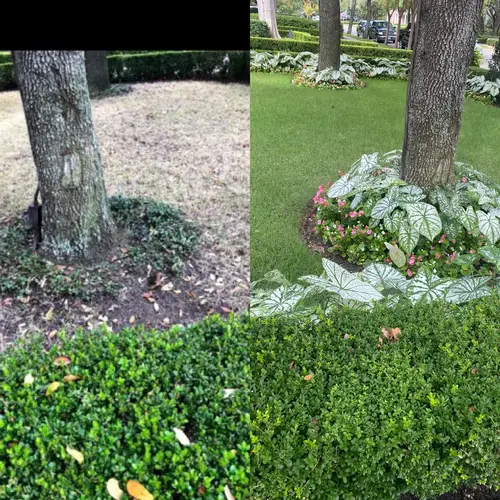
If your Dallas lawn has a yellowish tint despite adequate watering, if water ponds on the surface after irrigation, or if new grass struggles to establish in bare spots — the problem is almost certainly compacted soil. North Texas clay soils are naturally dense, and years of foot traffic, mowing, and vehicle weight make compaction worse. Core aeration is the single most effective treatment for reversing this damage, yet most homeowners skip it or do it at the wrong time.
What Is Soil Compaction & How Does It Develop?
Soil compaction occurs when external pressure squeezes soil particles closer together, reducing the pore space between them. In healthy soil, 50% of the volume is air and water space. In compacted Dallas clay, that can drop to 30% or less.
Compaction develops from:
- Foot traffic: The #1 cause in residential lawns. High-traffic paths (backdoor to driveway, kids' play areas) compact first.
- Mowing: Every pass of a mower wheel compresses the top 1–2 inches of soil. Over a growing season, this adds up.
- Vehicles: Parking on the lawn, even occasionally, creates severe compaction that takes years to recover.
- Construction: New builds and landscape projects leave soil heavily compacted from heavy equipment.
- Wet conditions: Working soil when it's wet (walking, dragging equipment) causes the most damage because clay particles slide into each other's pores.
How Compaction Harms Your Lawn
- Reduced water infiltration: Water can't penetrate compacted soil, leading to surface runoff, pooling, and paradoxical drought stress below the surface
- Oxygen deprivation: Roots need oxygen to respire. Compact soil chokes root zones, weakening the entire plant
- Limited root depth: Roots can't push through dense clay, creating a shallow root system that can't access deep moisture reserves
- Reduced nutrient availability: Fertilizer applied to the surface can't reach roots if water can't carry it down
- Increased thatch: Shallow roots die and decompose at the surface, adding to thatch buildup, which further insulates and compacts the soil below
- Weed invasion: Stressed, thin turf creates openings for crabgrass and other weeds that exploit weak areas
Core Aeration vs. Spike Aeration
Not all aeration is created equal:
| Type | How It Works | Effectiveness |
|---|---|---|
| Core aeration (plug aerator) | Removes cylindrical plugs of soil (½–⅝ inch diameter, 2–4 inches deep), creating open channels | Excellent — creates permanent pathways for air, water, and nutrients; plugs decompose and add organic matter |
| Spike aeration | Punches solid holes into the soil without removing material | Poor — the holes close back up as clay soil swells and contracts; can actually worsen compaction by creating a "bottleneck" around each spike |
Always use core aeration. Spike aerators are a waste of time on clay soils. If a service quotes you for "spike aeration," find another provider.
When to Aerate in Dallas
- Best window: Late March to April — as warm-season grasses break dormancy and begin active growth. The lawn heals quickly from aeration holes, and the open channels are immediately available for spring root growth.
- Second option: Early fall (September–October) — allows roots to grow into the channels before winter dormancy.
- Avoid: Peak summer heat (July–August) when the lawn is already stressed, and deep winter when the grass is dormant and won't recover the holes.
How Often Should You Aerate?
- High-traffic lawns: Annually, without exception
- Clay soil (most of Dallas): Annually at minimum; every 6 months for severely compacted areas
- New construction lawns: Every 6 months for the first 3 years while the soil structure establishes
- Low-traffic, sandy soils: Every 2–3 years may suffice (rare in Dallas)
What to Expect During & After Aeration
During: A professional core aerator makes 10,000–20,000 holes per acre. The process takes 1–3 hours depending on lawn size. You'll see thousands of small soil plugs covering the surface.
First 48 hours: The plugs dry and become brittle. Mow over them (set mower slightly lower than normal) to break them into small fragments that fall back into the holes, adding organic matter to the soil profile.
Week 1–2: Water normally. The open channels allow water to penetrate deeply for the first time in possibly years. You may notice the lawn "drinking" the water instead of it running off.
Week 2–6: New root growth pushes into the aeration channels. The lawn fills in and the holes disappear. By 4–6 weeks, the surface looks normal but the soil structure below is dramatically improved.
Maximizing Aeration Results: Follow-Up Steps
- Overseed (if applicable): For cool-season overseeding, aerate first, then seed into the open holes for maximum germination contact.
- Topdress with compost: Spread ¼ inch of compost over the aerated lawn within 48 hours. It falls into the holes and directly amends the subsoil.
- Fertilize: Apply a balanced fertilizer 1–2 weeks after aeration. The open channels deliver nutrients directly to the root zone.
- Lime (if needed): Dallas soils are often alkaline (pH 7.5–8.0), so lime is rarely needed. However, if your soil test shows pH above 8.0, apply sulfur instead. Aeration helps these amendments penetrate deeper.
Annual Aeration Included in Our Lawn Programs
Every seasonal maintenance contract includes professional core aeration at the optimal time for your grass type. One visit transforms your soil structure for the entire growing season.
Get a Free Soil Assessment